
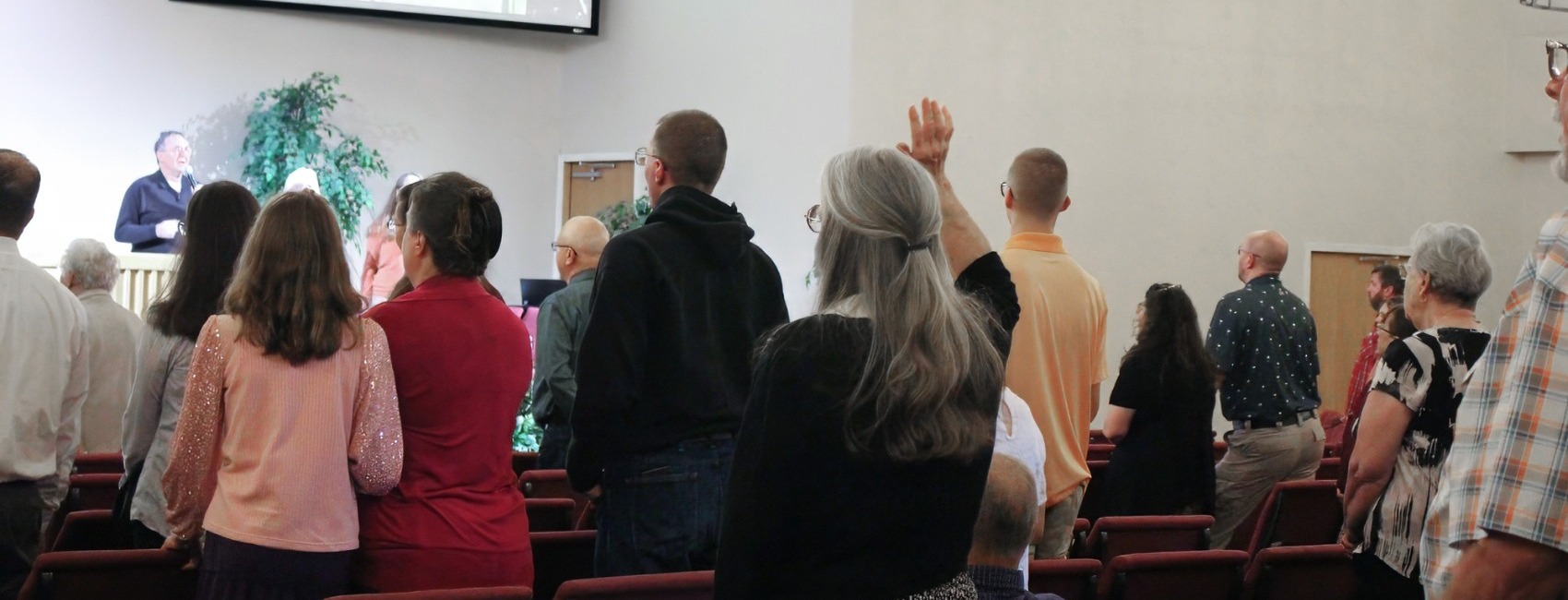
What We Strive For
At Grace Bible Fellowship, we gather to glorify God through worship, grow together in the truth of His Word, and live lives that reflect the transforming power of the gospel. Our desire is to be a community shaped by Scripture—encouraging one another toward greater love, faithfulness, and obedience to Jesus Christ.
Who We Are
Grace Bible Fellowship of Albany, Oregon is a body of believers devoted to the authority of God’s Word, the centrality of the gospel, and the mission of making disciples. We exist to exalt Christ in all things, build up His church, and faithfully proclaim the truth that leads to salvation and godly living.
Our Mission
We are called to:
- Proclaim the gospel with clarity and conviction (Matthew 28:19–20)
- Teach the whole counsel of God through expository preaching and discipleship (2 Timothy 3:16–17)
- Equip believers to live lives marked by holiness, love, and service (Ephesians 4:11–13)
- Glorify God in all that we do, as we await the return of our Savior (1 Corinthians 10:31)
What We Believe
We believe the Bible is the inspired, inerrant Word of God and the final authority for faith and life.
We believe in one God—Father, Son, and Holy Spirit—who is sovereign over all things.
We believe salvation is by grace alone, through faith alone, in Christ alone.
We believe the church exists to worship God, build up believers, and proclaim the gospel to the world.
We believe in living out our faith with integrity, humility, and love, standing firm in biblical truth while extending the compassion of Christ to those around us.
Faith In Action
At Grace Bible Fellowship, outreach is at the heart of our mission to make Christ known both here at home and around the world. We believe the gospel transforms lives, and we desire to faithfully proclaim and demonstrate that truth through word and action. Whether serving in our own community or supporting global missions, our goal is to glorify God by reaching people with the hope of Jesus Christ, equipping disciples, and extending His love to others.
Our Doctrinal Distinctives
Below are the core beliefs of Grace Bible Fellowship. By these beliefs, GBF operates and flows as a unified church, and as a productive member of the Body of Christ.
We teach that the Bible is God’s written revelation to man, and thus the sixty six books of the Bible given to us by the Holy Spirit constitute the plenary (inspired equally in all parts) Word of God (1 Corinthians 2:7-14; 2 Peter 1:20, 21).
We teach that the Word of God is an objective, propositional revelation (1 Thessalonians 2:13; 1 Corinthians 2:13), verbally inspired in every word (2 Timothy 3:16), absolutely inerrant in the original documents, infallible, and God breathed. We teach the literal, grammatical historical interpretation of Scripture, which affirms the belief that the opening chapters of Genesis present creation in six literal days (Genesis 1:31; Exodus 31:17).
We teach that the Bible constitutes the only infallible rule of faith and practice (Matthew 5:18; 24:35; John 10:35; 16:12, 13; 17:17; 1 Corinthians 2:13; 2 Timothy 3:15-17; Hebrews 4:12; 2 Peter 1:20-21).
We teach that God spoke in His written Word by a process of dual authorship. The Holy Spirit so superintended the human authors that, through their individual personalities and different styles of writing, they composed and recorded God’s Word to man (2 Peter 1:20 21) without error in the whole or in the part (Matthew 5:18; 2 Timothy 3:16). We teach that, whereas there may be several applications of any given passage of Scripture, there is but one true interpretation. The meaning of Scripture is to be found as one diligently applies the literal grammatical historical method of interpretation under the enlightenment of the Holy Spirit (John 7:17; 16:12-15; 1 Corinthians 2:7-15; 1 John 2:20). It is the responsibility of believers to ascertain carefully the true intent and meaning of Scripture, recognizing that proper application is binding on all generations. Yet the truth of Scripture stands in judgment of men; never do men stand in judgment of it.
Psalm 19 on Scripture’s Sufficiency
Psalm 19:7–9 is one of the most monumental and concise statements on the sufficiency of Scripture found in the Scriptures. Penned by King David by the inspiration of the Holy Spirit, these three verses offer unwavering testimony from God Himself about the sufficiency of His Word for every situation. As a result, the ideas of those who believe that God’s Word must be augmented with truth gleaned from modern psychology or secular philosophy and reasoning fails to match the timeless and consistent reality of God’s Word as God’s truth. In this passage David makes six statements, each highlighting a characteristic of Scripture and describing its effect in the life of the one who embraces it. Taken together, these statements paint a beautiful picture of the sufficiency of God’s Word.
Scripture is perfect, restoring the soul.
In the first statement (v. 7), David says, “The law of the Lord is perfect, restoring the soul.” This word “perfect” is the translation of a common Hebrew word meaning “whole,” “complete,” or “sufficient.” It conveys the idea of something that is comprehensive, so as to cover all aspects of an issue. Scripture is comprehensive, embodying all that is necessary to one’s spiritual life. David’s implied contrast here is with the imperfect, insufficient, flawed reasoning of men.
God’s perfect law, David says, affects people by “restoring the soul” (v. 7). To paraphrase David’s words, Scripture is so powerful and comprehensive that it can convert or transform the entire person, changing someone into pre- cisely the person God wants him to be. God’s Word is sufficient to restore through salvation even the most broken life—a fact to which David himself gave abundant testimony.
Scripture is trustworthy, imparting wisdom.
David further expands the sweep of scriptural sufficiency in Psalm 19:7, writing, “The testimony of the Lord is sure, making wise the simple.” David’s use of the word “sure” means that the Lord’s testimony is unwavering, immovable, unmistakable, reliable, and worthy to be trusted. It provides a foundation on which to build one’s life and eternal destiny.
God’s sure Word makes the simple wise (v. 7). The Hebrew word translated “simple” comes from an expression meaning “an open door.” It evokes the image of a naive person who doesn’t know to shut his mind to false or impure teaching. He is undiscerning, ignorant, and gullible, but God’s Word makes him wise. Such a man is skilled in the art of godly living: He submits to Scripture and knows how to apply it to his circumstances. The Word of God thus takes a simple mind with no discernment and makes it skilled in the issues of life.
Scripture is right, causing joy.
In verse 8, David adds a third statement about Scripture’s sufficiency: “The precepts of the Lord are right, rejoicing the heart.” Rather than simply indicating what is right as opposed to wrong, the word translated “right” has the sense of showing someone the true path. The truths of Scripture lay out the proper path through the difficult maze of life. That brings a wonderful confidence. So many people are distressed or despondent because they lack direction and purpose, and most of them seek answers from the wrong sources. God’s Word not only provides the light to our path (Ps. 119:105), but also sets the route before us.
Because it steers us through the right course of life, God’s Word brings great joy. If one is depressed, anxious, fearful, or doubting, the solution is found not in self-indulgent pursuits like self-esteem and self-fulfillment. The solution is found in learning to obey God’s counsel and sharing in the resulting delight. Divine truth is the fount of true and lasting joy. All other sources are shallow and fleeting.
Scripture is pure, enlightening the eyes.
Psalm 19:8 gives a fourth characteristic of Scripture’s utter sufficiency: “The commandment of the Lord is pure, enlightening the eyes.” This word “pure” could better be translated “clear” or “lucid,” and it indicates that Scripture is not mystifying, confusing, or puzzling. God’s Word reveals truth to make the dark things light, bringing eternity into bright focus. Granted, there are things in Scripture that are hard to understand (2 Pet. 3:16), but taken as a whole, the Bible is not a bewildering book. It is clear and lucid.
Because of its absolute clarity, Scripture brings understanding where there is ignorance, order where there is confusion, and light where there is spiritual and moral darkness. It stands in stark contrast to the muddled musings of unredeemed men, who themselves are blind and unable to discern truth or live righteously. God’s Word clearly reveals the blessed, hopeful truths they can never see.
Scripture is clean, enduring forever.
In Psalm 19:9 David uses the term “fear” as a synonym for God’s Word: “The fear of the Lord is clean, enduring forever.” This “fear” speaks of the reverential awe for God that compels believers to worship Him. Scripture, in this sense, is the divine manual on how to worship the Lord. The Hebrew word “clean” speaks of the absence of impurity, filthiness, defilement, or imperfection. Scripture is without sin, evil, corruption, or error. The truth it conveys is therefore absolutely undefiled and without blemish.
Because it is flawless, Scripture endures forever (Ps. 19:9). Any change or modification could only introduce imperfection. Scripture is eternally and unalterably perfect. It needs no updating, editing, or refining, for it is God’s revelation for every generation. The Bible was written by the omniscient Spirit of God, who is infinitely more sophisticated than anyone who dares stand in judgment on Scripture’s relevancy for our society, and infinitely wiser than all the best philosophers, analysts, and psychologists who pass like a childhood parade into irrelevancy. Scripture has always been and will always be sufficient.
Scripture is true, altogether righteous.
Verse 9 provides the final characteristic and effect of God’s all-sufficient Word: “The judgments of the Lord are true; they are righteous altogether.” The word “judgments” in this context refers to ordinances or divine verdicts from the bench of the Supreme Judge of the earth. The Bible is God’s standard for judging the life and eternal destiny of every person. Because Scripture is true, it is “righteous altogether” (Ps. 19:9). The implication of that phrase is that its truthfulness produces a comprehensive righteousness in those who accept it.
Contrary to what many are teaching today, there is no need for additional revelations, visions, words of prophecy, or insights from modern psychology. In contrast to the theories of men, God’s Word is true and absolutely comprehensive. Rather than seeking something more than God’s glorious revelation, Christians need only to study and obey what they already have. Scripture is sufficient. (used with permission from: www.gracechurch.org/about/distinctives/index)
Expositional preaching, the practice of delivering sermons that systematically explain and apply the Scriptures, is critically important for both the corporate life of the church and the individual spiritual growth of Christians. This method of preaching aligns closely with biblical models and provides numerous theological and practical benefits.
Importance for the Church Corporately
- Upholding the Authority of Scripture: Expositional preaching ensures that the Bible, not the preacher, sets the agenda for the sermon. By systematically working through passages of Scripture, the congregation learns to value and rely on the Word of God as the ultimate authority. This approach reflects the practice of the early church, as seen in Acts 2:42, where believers devoted themselves to the apostles’ teaching.
- Ensuring Doctrinal Soundness: By expounding on the entirety of Scripture, expositional preaching helps safeguard the church from false doctrines and theological errors. It provides a balanced diet of biblical teaching, ensuring that difficult or less popular topics are not avoided. Paul exhorted Timothy to “preach the word; be prepared in season and out of season; correct, rebuke and encourage—with great patience and careful instruction” (2 Timothy 4:2).
- Promoting Spiritual Growth and Maturity: Systematic teaching through Scripture encourages spiritual growth and maturity within the congregation. It equips believers to understand the whole counsel of God (Acts 20:27) and to grow in their faith, becoming more Christ-like in character and action (Ephesians 4:11-13).
- Enhancing Unity and Cohesion: Expositional preaching fosters unity within the church by grounding the congregation in a shared understanding of Scripture. This common foundation helps to prevent divisions and promotes a sense of corporate identity and purpose, as encouraged in 1 Corinthians 1:10.
Importance for Christians Individually
- Deepening Biblical Knowledge: Expositional preaching helps individuals gain a comprehensive and coherent understanding of the Bible. This deepened knowledge enables believers to navigate life’s challenges with biblical wisdom and discernment (Psalm 119:105).
- Encouraging Personal Application: By explaining and applying Scripture, expositional preaching encourages individuals to apply biblical principles to their own lives. This practice fosters personal holiness and transformation, as believers are called to “be doers of the word, and not hearers only” (James 1:22).
- Strengthening Faith and Conviction: Regular exposure to the systematic teaching of God’s Word builds a strong foundation of faith and conviction. It helps believers to stand firm in their beliefs, even in the face of cultural pressures and personal trials, as urged in Colossians 2:6-7.
- Fostering a Love for Scripture: Expositional preaching models how to study and interpret the Bible effectively, encouraging individuals to engage with Scripture on their own. This practice cultivates a lifelong love for God’s Word and a commitment to personal Bible study (Psalm 1:2).
Conclusion
Expositional preaching is essential for the health and vitality of the church and the spiritual well-being of individual Christians. It upholds the authority of Scripture, ensures doctrinal soundness, promotes spiritual growth and unity, deepens biblical knowledge, encourages personal application, strengthens faith, and fosters a love for God’s Word. By committing to this method of preaching, the church fulfills its calling to “preach the Word” faithfully and effectively (2 Timothy 4:2), ensuring that both the corporate body and individual believers are thoroughly equipped for every good work (2 Timothy 3:16-17).
We teach that there is but one living and true God (Deuteronomy 6:4; Isaiah 45:5 7; 1 Corinthians 8:4), an infinite, all knowing Spirit (John 4:24), perfect in all His attributes, one in essence, eternally existing in three Persons—Father, Son, and Holy Spirit (Matthew 28:19; 2 Corinthians 13:14)—each equally deserving worship and obedience.
God the Father
We teach that God the Father, the first Person of the Trinity, orders and disposes all things according to His own purpose and grace (Psalm 145:8 9; 1 Corinthians 8:6). He is the Creator of all things (Genesis 1:1 31; Ephesians 3:9). As the only absolute and omnipotent Ruler in the universe, He is sovereign in creation, providence, and redemption (Psalm 103:19; Romans 11:36). His fatherhood involves both His designation within the Trinity and His relationship with mankind. As Creator He is Father to all men (Ephesians 4:6), but He is spiritual Father only to believers (Romans 8:14; 2 Corinthians 6:18). He has decreed for His own glory all things that come to pass (Ephesians 1:11). He continually upholds, directs, and governs all creatures and events (1 Chronicles 29:11). In His sovereignty He is neither author nor approver of sin (Habakkuk 1:13; John 8:38 47), nor does He abridge the accountability of moral, intelligent creatures (1 Peter 1:17). He has graciously chosen from eternity past those whom He would have as His own (Ephesians 1:4 6); He saves from sin all who come to Him through Jesus Christ; He adopts as his own all those who come to Him; and He becomes, upon adoption, Father to His own (John 1:12; Romans 8:15; Galatians 4:5; Hebrews 12:5 9).
God the Son
We teach that Jesus Christ, the second Person of the Trinity, possesses all the divine excellencies, and in these He is coequal, consubstantial, and coeternal with the Father (John 10:30; 14:9).
We teach that God the Father created according to His own will, through His Son, Jesus Christ, by whom all things continue in existence and in operation (John 1:3; Colossians 1:15 17; Hebrews 1:2).
We teach that in the incarnation (God becoming man) Christ surrendered only the prerogatives of deity but nothing of the divine essence, either in degree or kind.
In His incarnation, the eternally existing second Person of the Trinity accepted all the essential characteristics of humanity and so became the God Man (Philippians 2:5 8; Colossians 2:9). We teach that Jesus Christ represents humanity and deity in indivisible oneness (Micah 5:2; John 5:23; 14:9 10; Colossians 2:9).
We teach that our Lord Jesus Christ was virgin born (Isaiah 7:14; Matthew 1:23, 25; Luke 1:26 35); that He was God incarnate (John 1:1, 14); and that the purpose of the incarnation was to reveal God, redeem men, and rule over God’s kingdom (Psalm 2:7 9; Isaiah 9:6; John 1:29; Philippians 2:9 11; Hebrews 7:25 26; 1 Peter 1:18 19).
We teach that, in the incarnation, the second person of the Trinity laid aside His right to the full prerogatives of coexistence with God, assumed the place of a Son, and took on an existence appropriate to a servant while never divesting Himself of His divine attributes (Philippians 2:5 8).
We teach that our Lord Jesus Christ accomplished our redemption through the shedding of His blood and sacrificial death on the cross and that His death was voluntary, vicarious, substitutionary, propitiatory, and redemptive (John 10:15; Romans 3:24 25; 5:8; 1 Peter 2:24).
We teach that our justification is made sure by His literal, physical resurrection from the dead and that He is now ascended to the right hand of the Father, where He now mediates as our Advocate and High Priest (Matthew 28:6; Luke 24:38 39; Acts 2:30 31; Romans 4:25; 8:34; Hebrews 7:25; 9:24; 1 John 2:1).
We teach that in the resurrection of Jesus Christ from the grave, God confirmed the deity of His Son and gave proof that God has accepted the atoning work of Christ on the cross. Jesus’ bodily resurrection is also the guarantee of a future resurrection life for all believers (John 5:26 29; 14:19; Romans 1:4; 4:25; 6:5 10; 1 Corinthians 15:20, 23).
We teach that Jesus Christ will return to receive the church, which is His Body, unto Himself at the rapture, and returning with His church in glory, will establish His millennial kingdom on earth (Acts 1:9 11; 1 Thessalonians 4:13 18; Revelation 20).
We teach that the Lord Jesus Christ is the One through whom God will judge all mankind (John 5:22 23):
a. Believers (1 Corinthians 3:10 15; 2 Corinthians 5:10)
b. Living inhabitants of the earth at His glorious return (Matthew 25:31 46).
c. Unbelieving dead at the Great White Throne (Revelation 20:11 15).
As the Mediator between God and man (1 Timothy 2:5), the Head of His Body the church (Ephesians 1:22; 5:23; Colossians 1:18), and the coming universal King, who will reign on the throne of David (Isaiah 9:6; Luke 1:31 33), He is the final Judge of all who fail to place their trust in Him as Lord and Savior (Matthew 25:14 46; Acts 17:30 31). We teach that on the basis of the efficacy of the death of our Lord Jesus Christ, the believing sinner is freed from the punishment, the penalty, the power, and one day the very presence of sin; and that he is declared righteous, given eternal life, and adopted into the family of God (Romans 3:25; 5:8 9; 2 Corinthians 5:14 15; 1 Peter 2:24; 3:18).
God the Holy Spirit
We teach that the Holy Spirit is a divine Person, eternal, underived, possessing all the attributes of personality and deity including intellect (1 Corinthians 2:10 13), emotions (Ephesians 4:30), will (1 Corinthians 12:11), eternality (Hebrews 9:14), omnipresence (Psalm 139:7 10), omniscience (Isaiah 40:13 14), omnipotence (Romans 15:13), and truthfulness (John 16:13). In all the divine attributes He is coequal and consubstantial with the Father and the Son (Matthew 28:19; Acts 5:3 4; 28:25 26; 1 Corinthians 12:4 6; 2 Corinthians 13:14; and Jeremiah 31:31 34 with Hebrews 10:15 17).
We teach that it is the work of the Holy Spirit to execute the divine will with relation to all mankind. We recognize His sovereign activity in creation (Genesis 1:2), the incarnation (Matthew 1:18), the written revelation (2 Peter 1:20 21), and the work of salvation
We teach that the work of the Holy Spirit in this age began at Pentecost when He came from the Father as promised by Christ (John 14:16 17; 15:26) to initiate and complete the building of the Body of Christ, which is His church (1 Corinthians 12:13). The broad scope of His divine activity includes convicting the world of sin, of righteousness, and of judgment; glorifying the Lord Jesus Christ and transforming believers into the image of Christ (John 16:7 9; Acts 1:5; 2:4; Romans 8:29; 2 Corinthians 3:18; Ephesians 2:22).
We teach that the Holy Spirit is the supernatural and sovereign Agent in regeneration, baptizing all believers into the Body of Christ (1 Corinthians 12:13). The Holy Spirit also indwells, sanctifies, instructs, empowers them for service, and seals them unto the day of redemption (Romans 8:9; 2 Corinthians 3:6; Ephesians 1:13).
We teach that the Holy Spirit is the divine Teacher, who guided the apostles and prophets into all truth as they committed to writing God’s revelation, the Bible. Every believer possesses the indwelling presence of the Holy Spirit from the moment of salvation, and it is the duty of all those born of the Spirit to be filled with (controlled by) the Spirit (John 16:13; Romans 8:9; Ephesians 5:18; 2 Peter 1:19 21; 1 John 2:20, 27).
We teach that the Holy Spirit administers spiritual gifts to the church. The Holy Spirit glorifies neither Himself nor His gifts by ostentatious displays, but He does glorify Christ by implementing His work of redeeming the lost and building up believers in the most holy faith (John 16:13 14; Acts 1:8; 1 Corinthians 12:4 11; 2 Corinthians 3:18).
We teach, in this respect, that God the Holy Spirit is sovereign in the bestowing of all His gifts for the perfecting of the saints today and that speaking in tongues and the working of sign miracles in the beginning days of the church were for the purpose of pointing to and authenticating the apostles as revealers of divine truth, and were never intended to be characteristic of the lives of believers (1 Corinthians 12:4 11; 13:8 10; 2 Corinthians 12:12; Ephesians 4:7 12; Hebrews 2:14).
We teach that God directly and immediately created man in His image and likeness. Man was created free of sin with a rational nature, intelligence, volition, self-determination, and moral responsibility to God (Genesis 2:7, 15 25; James 3:9).
We teach that God’s intention in the creation of man was that man should glorify God, enjoy God’s fellowship, live his life in the will of God, and by this accomplish God’s purpose for man in the world (Isaiah 43:7; Colossians 1:16; Revelation 4:11).
Marriage
We teach that when God created mankind (Gen. 2:24), He created them male and female (Matthew 19:4-6). As such He created them with different functions so that they complement each other in their relationship to one another and in the family (Ephesians 5:22-33). God instituted monogamous marriage between men and women as the foundation of the family (Col 3:18-21). Marriage is the lifelong covenant union between a man and woman (Matthew 19:1-12).
Humanity’s Sinful Nature
We teach that in Adam’s sin of disobedience to the revealed will and Word of God, man lost his innocence; incurred the penalty of spiritual and physical death; became subject to the wrath of God; and became inherently corrupt and utterly incapable of choosing or doing that which is acceptable to God apart from divine grace. With no recuperative powers to enable him to recover himself, man is hopelessly lost. Man’s salvation is thereby wholly of God’s grace through the redemptive work of our Lord Jesus Christ (Genesis 2:16 17; 3:1 19; John 3:36; Romans 3:23; 6:23; 1 Corinthians 2:14; Ephesians 2:1 3; 1 Timothy 2:13 14; 1 John 1:8).
We teach that because all men were in Adam, a nature corrupted by Adam’s sin has been transmitted to all men of all ages, Jesus Christ being the only exception. All men are thus sinners by nature, by choice, and by divine declaration (Psalm 14:1 3; Jeremiah 17:9; Romans 3:9 18, 23; 5:10 12).
Though divorce is ubiquitous in human history and most people have been affected by it in some way, the truth of Scripture is that God hates divorce (Mal 2:14-16) and it was never His plan. He hates it because it always involves a breaking of the solemn covenant of marriage that men and women have entered into, and because it brings harmful consequences to those individuals, their children, and their extended families. Ultimately, divorce in the Scripture is permitted as a result of man’s sin. Since divorce is only a concession to man’s sin and is not part of God’s original plan for marriage, all believers should likewise hate divorce as God does and pursue it only when there is no other recourse. Believers must also understand that, with God’s help, a marriage can survive the worst sins and there are many examples of families being reconciled even after terrible circumstances.
Regarding when divorce is permitted, in Matthew 19:3-9, Christ teaches that divorce is an accommodation to man’s sin that violates God’s original purpose for the intimate unity and permanence of the marriage bond (Gen. 2:24). He taught that God’s law allowed divorce only because of the “hardness of heart” of sinful man (Matt. 19:8). Legal divorce was a concession for the faithful spouse due to the sexual sin or abandonment by the sinning spouse, so that the faithful spouse was no longer bound to the marriage (Matt. 5:32; 19:9; 1 Cor. 7:12-15). The issue of abandonment should be understood as broader than abandoning a home, and includes the abandonment of covenant vows to love, cherish, provide and protect one another, such as in the case of physical abuse.
It should be noted that, although Jesus did say that divorce is permitted in some situations, we must remember that His primary point in this discourse is to correct the Jews’ idea that they could divorce one another “for any cause at all” (Matt. 19:3), and to show them the gravity of pursuing a sinful divorce. Therefore, the believer should never consider divorce except in specific circumstances, and even in those circumstances it should only be pursued reluctantly because there is no other recourse.
The Grounds for Divorce
The only New Testament grounds for divorce are sexual sin or abandonment by an unbeliever. The first is found in Jesus’ use of the Greek word porneia (Matt. 5:32; 19:9). This is a general term that encompasses sexual sin such as adultery, homosexuality, bestiality, and incest. When one partner violates the unity and intimacy of a marriage by sexual sin—and forsakes his or her covenant obligation—the faithful partner is placed in an extremely difficult situation. After all means are exhausted to bring the sinning partner to repentance, the Bible permits release for the faithful partner through divorce (Matt. 5:32; 1 Cor. 7:15).
A second reason for permitting a divorce is in cases where an unbelieving spouse does not desire to live with his or her believing spouse (1 Cor. 7:12-15). Because “God has called us to peace” (v. 15), divorce is allowed and may be preferable in such situations. When an unbeliever desires to leave, trying to keep him or her in the marriage may only create greater tension and conflict. Also, if the unbeliever leaves the marital relationship permanently but is not willing to file for divorce, perhaps because of lifestyle, irresponsibility, or to avoid monetary obligations, then the believer is in an impossible situation of having legal and moral obligations that he or she cannot fulfill. Because “the brother or sister is not under bondage in such cases” (1 Cor. 7:15) and is therefore no longer obligated to remain married, the believer may file for divorce without fearing the displeasure of God.
In the case of physical abuse, the abusing spouse is demonstrating that he/she has rejected the Gospel’s call to true repentance and a transformed life that is a spiritual service of worship (Rom. 12:1) and is an unbeliever. A believing spouse has the freedom to notify proper authorities and is free to separate themselves from danger with no obligation to place themselves into a known dangerous situation.
The Possibility of Remarriage
Remarriage is permitted for the faithful spouse only when the divorce was on biblical grounds. In fact, the purpose for a biblical divorce is to make clear that the faithful partner is free to remarry, but only in the Lord (Rom. 7:1-3; 1 Cor. 7:39). Those who divorce on any other grounds have sinned against God and their spouses, and for them to marry another is an act of “adultery” (Mark 10:11-12). This is why Paul says that a believing woman who sinfully divorces should “remain unmarried, or else be reconciled to her husband” (1 Cor. 7:10-11). If she repents from her sin of unbiblical divorce, the true fruits of that repentance would be to seek reconciliation with her former husband as long as a remarriage has not occurred for either person (Matt. 5:23-24). The same is true for a man who divorces unbiblically (1 Cor. 7:11). The only time such a person could remarry another is if the former spouse remarries, proves to be an unbeliever, or dies, in which cases reconciliation would no longer be possible.
The Bible also gives a word of caution to anyone who is considering marriage to a divorcee. If the divorce was not on biblical grounds and there is still a responsibility to reconcile, the person who marries the divorcee is considered an adulterer (Mark 10:12).
The Role of the Church
Believers who pursue divorce on unbiblical grounds are subject to church discipline because they openly reject the Word of God. The one who obtains an unbiblical divorce and remarries is guilty of adultery since God did not permit the original divorce (Matt. 5:32; Mark 10:11-12). That person is subject to the steps of church discipline as outlined in Matthew 18:15-17. If a professing Christian violates the marriage covenant and refuses to repent during the process of church discipline, Scripture instructs that he or she should be put out of the church and treated as an unbeliever (v. 17). When the discipline results in such a reclassification of the disobedient spouse as an “outcast” or unbeliever, the faithful partner would be free to divorce according to the provision for divorce as in the case of an unbeliever departing, as stated in 1 Corinthians 7:15. Before such a divorce, however, reasonable time should be allowed for the possibility of the unfaithful spouse returning because of the discipline.
The leadership in the local church should also help single believers who have been divorced to understand their situation biblically, especially in cases where the appropriate application of biblical teaching does not seem clear. For example, the church leadership may at times need to decide whether one or both of the former partners could be legitimately considered “believers” at the time of their past divorce, because this will affect the application of biblical principles to their current situation (1 Cor. 7:17-24). Also, because people often transfer to or from other churches and many of those churches do not practice church discipline, it might be necessary for the leadership to decide whether a member’s estranged or former spouse should currently be considered a Christian or treated as an unbeliever because of continued disobedience. Again, in some cases this would affect the application of the biblical principles (1 Cor. 7:15; 2 Cor. 6:14).
Pre-conversion Divorce
According to 1 Corinthians 7:20-27, there is nothing in salvation that demands a particular social or marital status. The Apostle Paul, therefore, instructs believers to recognize that God providentially allows the circumstances they find themselves in when they come to Christ. If they were called while married, then they are not required to seek a divorce (even though divorce may be permitted on biblical grounds). If they were called while divorced, and cannot be reconciled to their former spouse because that spouse is an unbeliever or is remarried, then they are free to either remain single or be remarried to another believer (1 Cor. 7:39; 2 Cor. 6:14).
Repentance & Forgiveness
In cases where divorce took place on unbiblical grounds and the guilty partner later repents, the grace of God is operative at the point of repentance. A sign of true repentance will be a desire to implement 1 Corinthians 7:10-11, which would involve a willingness to pursue reconciliation with his or her former spouse, if that is possible. If reconciliation is not possible, however, because the former spouse is an unbeliever or is remarried, then the forgiven believer could pursue another relationship under the careful guidance and counsel of church leadership. In cases where a believer obtained a divorce on unbiblical grounds and remarried, he or she is guilty of the sin of adultery until that sin is confessed (Mark 10:11-12). God does forgive that sin immediately when repentance takes place, and there is nothing in Scripture to indicate anything other than that. From that point on the believer should continue in his or her current marriage. (Used with permission from www.gracechurch.org/about/distinctives/index)